|
Korean students take diplomacy into their own hands in China
2026.01.12 | The Korea Herald 2025.01.12 |
|
|---|---|
|
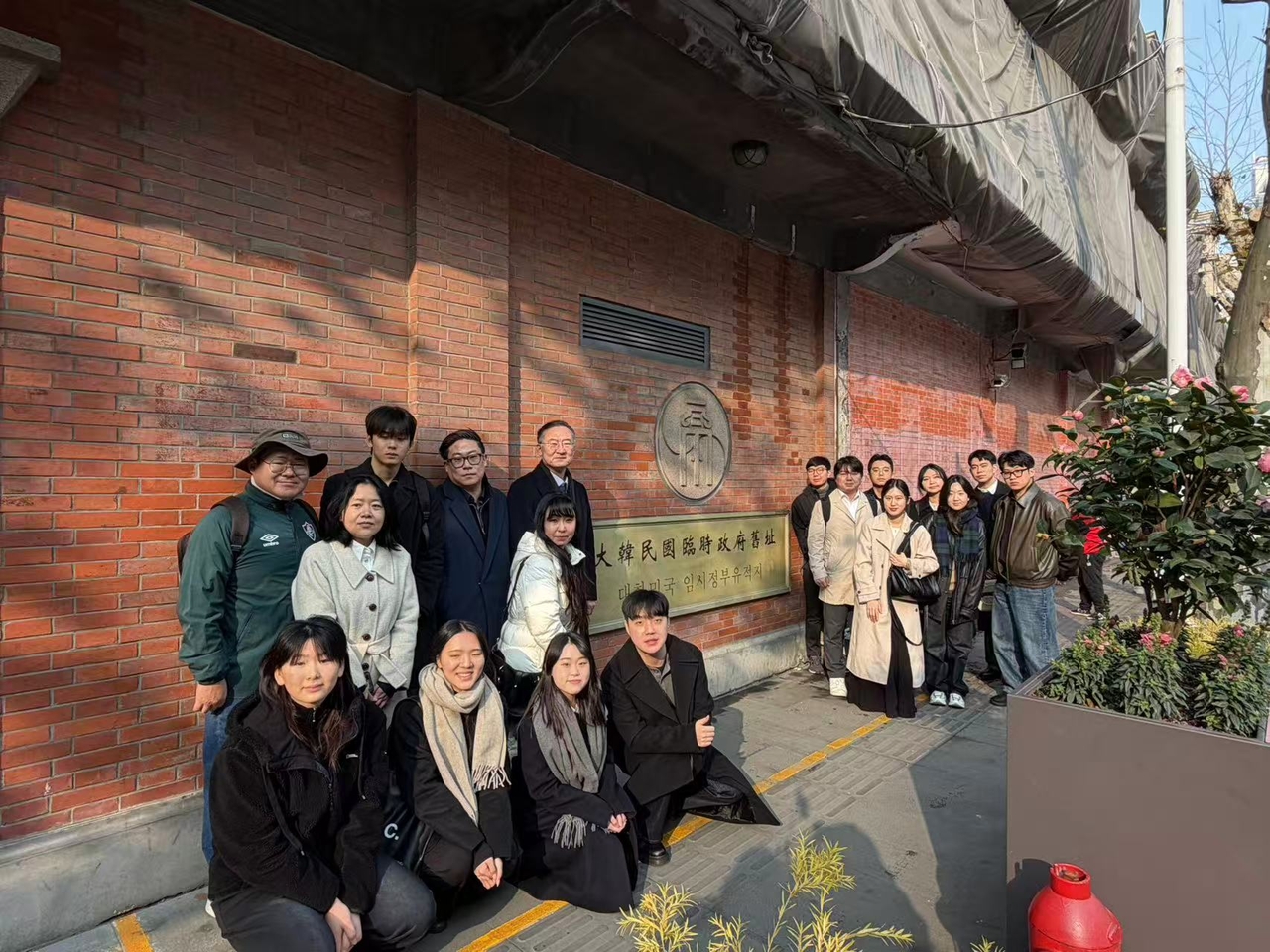
Professors and students from Hankuk University of Foreign Studies’ Division of International Studies visit the former headquarters of the Provisional Government of the Republic of Korea in Shanghai on Jan. 6. (Courtesy of Hwang Jae-ho, professor at Hankuk University of Foreign Studies) As President Lee Jae Myung sought to put Korea–China diplomacy back on track, a delegation of Korean students moved in parallel, opening a new lane for youth exchange. Professors and students from Hankuk University of Foreign Studies’ Division of International Studies traveled to Shanghai and Hangzhou from Jan. 5 to 8 for a program built around three pillars: youth dialogue, historical reflection and visits to major Chinese companies. The visit opened on Jan. 5 with a discussion between South Korean and Chinese university students at Shanghai International Studies University on the role of youth in advancing South Korea–China relations, according to Hwang Jae-ho, a professor at Hankuk University of Foreign Studies. On Jan. 6, the delegation traced the geography of Korea’s independence movement, visiting the former headquarters of the provisional government in Shanghai and Hongkou Park. Shanghai holds particular symbolism: it was where Kim Koo began writing his autobiography, Baekbeomilji, and where the legendary independence fighter Yun Bong-gil hurled a bomb at Hongkou Park — now known as Lu Xun Park — targeting senior leaders of the Japanese Imperial Army in 1932. Lee also visited both sites on Jan. 7 during his four-day state visit to China, which took him to Beijing and Shanghai from Jan. 4 to 7, invoking a shared historical backdrop to Korea’s independence movement under Japan’s colonial rule. After traveling to Hangzhou, the delegation visited Zhejiang University on Jan. 7, where students exchanged views on the future course of South Korea–China cooperation through people-to-people dialogue grounded in the humanities. Later that day, the group toured Alibaba’s headquarters, gaining a close look at the technological reach of one of China’s flagship companies. The following day, it visited a former site of Korea’s provisional government in Hangzhou. Hwang Jae-ho, who led the delegation, noted that the spread of negative public perceptions since the THAAD dispute — which erupted after the deployment of a US missile defense battery in South Korea — is “a reality” in both countries. “Antagonistic sentiments — ‘anti-China’ in South Korea and ‘anti-Korea’ in China — now exist in both societies,” Hwang said. “Healing them will take a considerable period of recovery.” That, he emphasized, is precisely why youth exchange matters. “As the vanguard of people-to-people diplomacy, youth exchange is a kind of magic lamp that can reduce mutual aversion,” Hwang said. “But it must be sustained consistently to produce results years from now. A shift in mindset among the younger generation is essential, and we need to take a gradual, step-by-step approach.” For the students, the trip offered a compact lesson in how relationships are repaired — through small, repeated acts rather than sweeping declarations. One participant described young people as those who “remember experiences, connect them, and turn them into cooperation,” urging that such visits not remain a one-off gesture. The university trip followed an unexpected moment of traction on Nov. 1, when Xi — visiting South Korea during the APEC summit — referenced a letter from Korean students at a state banquet hosted by Lee after their one-on-one summit. Xi said he had received the letter, sent by HUFS students in October, and that he “felt hope for the development of China–South Korea relations,” adding that “youth are the future of China–Korea ties.” Ji Da-gyum dagyumji@heraldcorp.com |