|
Legacy of Woncheuk inspires modern China-South Korea exchanges
2025.10.23 | Global Times 2025.10.23 |
|
|---|---|
|
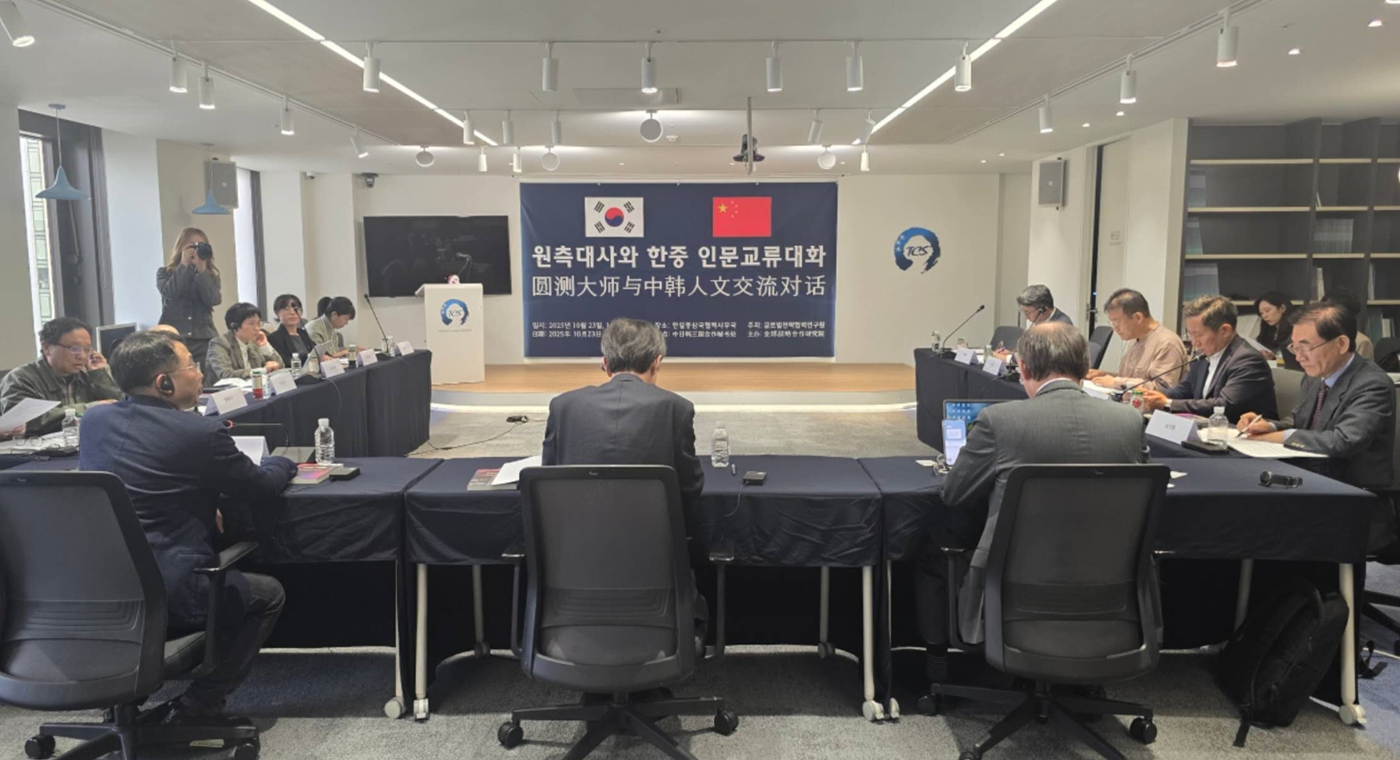
Photo: Courtesy of the Institute for Global Strategy & Cooperation in South Korea Story of eminent monk ‘vivid epitome’ of friendship In Xi'an, Shaanxi Province, at the Xingjiao Temple, next to Xuanzang's sarira stupa stands quietly another spiritual pagoda where lies eternally a prince from the ancient kingdom of Silla who never returned to his homeland after arriving in China during the Tang Dynasty (618-907) to seek Buddhist knowledge. Thirteen hundred years later, Jaeho Hwang, director of the Institute for Global Strategy & Cooperation in South Korea, stood before the sarira stupa of Monk Woncheuk and felt a profound, timeless call from history: "This Silla monk, who journeyed to Chang'an in his youth bearing books, might offer new inspiration for South Korea and China's cultural exchanges." A high-level forum themed "Master Woncheuk and China-South Korea Cultural Exchange and Cooperation" was held at the conference room of the Trilateral Cooperation Secretariat (TCS) in Seoul on Thursday. Convened just ahead of the upcoming APEC meeting in Gyeongju, the meeting sought to draw insights from the life of this eminent Tang Dynasty monk to address contemporary bilateral relations. The life of Master Woncheuk (613-696) itself is a legend. This eminent monk, born into the Silla royal family, journeyed to Chang'an, capital of Tang Dynasty, at the age of 15. He studied under Master Xuanzang, a Chinese Buddhist monk, scholar, traveler and translator who traveled to India in the seventh century and translated Buddhist scriptures, mastered several languages, and became a leading figure of the Faxiang (Consciousness-Only) School. In his written address, Dai Bing, China's ambassador to South Korea, remarked, "The legendary story of Master Woncheuk is a vivid epitome of the millennium-old friendship and mutual learning between the civilizations of China and South Korea, as well as a precious heritage that we collectively share." "The philosophical wisdom of Master Woncheuk - 'seeking common ground while reserving differences and synthesizing diverse perspectives' - precisely illuminates a path for today's bilateral relations. It serves not only as a key to enhancing mutual understanding but also as a cornerstone for building inclusive relations," Hwang told the Global Times. "The master's life and philosophy can not only foster a positive public opinion environment between the two countries, but also strengthen the emotional bonds between our peoples." Lee Tae-hee, senior curator of the National Museum of Korea, noted at the meeting that Woncheuk's philosophy is a "composite product of intellectual exchanges in East Asian Buddhism and political networks," and his activities represent "a key example of the formation of the East Asian Buddhist cultural sphere." Particularly symbolic is the fact that Xi'an, Woncheuk's final resting place, and Gyeongju, his hometown, have a cultural bond spanning more than 1,000 years. In 2014, the Xingjiao Temple Pagoda housing his sarira was inscribed on the World Heritage List as a "Silk Road" site; while Gyeongju, the host city of the 2025 APEC meeting, is the hometown of this eminent monk. "In one week, the APEC meeting will commence in Woncheuk's hometown. This presents a new and important opportunity for the improvement and development of China-South Korea relations. It requires more visionary individuals to engage in cultural exchanges and cooperation between the two countries, playing an active role in enhancing nongovernmental interactions and mutual understanding, and thereby strengthening public support for bilateral relations," Ambassador Dai Bing stated. Bai Genxing, president of the Chinese Tang History Society, noted that Woncheuk's journey to Tang China "demonstrates the integrated development of the East Asian cultural sphere in the early Tang period," when monks "collaboratively used Chinese characters and language to translate Indian Buddhist scriptures, jointly promoting the Sinicization of Buddhism." Chinese performer Wang Xincang, who has portrayed Master Xuanzang in multiple Qinqiang Opera productions, interpreted the teacher-disciple bond between Woncheuk and Xuanzang from an artistic perspective: "This transnational relationship reveals the purest form of cultural exchange - unrelated to power or interests, but centered on the shared pursuit of truth." He noted that from Woncheuk's spread of Buddhist teachings to Korean scholar Choi Chiwon's scholarly pursuits, nations have "consistently achieved mutual growth through cultural dialogue." Even more symbolic was the announcement made on site by Liu Zhen, council member of the Shaanxi Provincial People's Association for Friendship with Foreign Countries, of a touching initiative: A statue of Master Woncheuk will be created and sent to Gyeongju in 2026 for the 1,330th anniversary of the master's passing, "allowing Master Woncheuk to return home for a visit." This "homecoming" plan, spanning over 1,300 years, has been endowed with new contemporary significance. "This Silla royal descendant, who entered Tang China at 15 and passed away at 84 without returning, will now come back to his homeland in a special way, becoming a new bond for cultural exchange between our two countries," Liu emotionally stated. By Xu Liuliu |